getting attention
Current media coverage, active campaigns, public involvement and creative interventions, in the debate that has been running since at least 1952.

Inspiration
If you are thinking of starting a campaign for a statue or memorial honouring women and would like to find some wonderful inspiration for ways of getting attention just check the tactics used in campaigns like those for Mary Wollstonecraft and Emmeline Pankhurst.
What a brainwave to project Mary Wollstonecraft's image on to the Houses of Parliament, a great way to get her in the public eye.
And imagine the power of organising a public vote like the one in Manchester to start the conversation and get a real sense from the wider public about who they truly value.
The energetic, effective campaign, led by engineer Jane Priston, to celebrate the astonishing achievements of pioneering aviator Amy Johnson resulted in not one but two beautiful, lively statues.

So that’s a thought to bear in mind; is there more than one place that is significant in the life of the person or group that you are campaigning for? Once the sculptor’s work is done, more than one cast can be made. We have such a lot of ground to make up in terms of the recognition of women that this is a strategy worth considering. Amy was important both to the people of Hull where she was born and in Herne Bay where she died.

Another clever feature of these statues is that even without a sound component they still allow Amy’s inspiring words to reach us through engravings of her words on the surface of the statue.

Changing Attitudes
And for some food for thought from the USA take a look at the Moving On page for the Millie Dresselhaus video. Attitudes are changing everywhere.

The clever "Wifies" - www.wifie.org.uk - in Edinburgh made life size portraits (above) of the women they wanted to see honoured, then set them around the city: a real call to action.
Sheffield City Council used the “Just Giving” site as part of their fundraising efforts. They attracted 295 supporters and exceeded their goal of raising £150,000 and actually got £163,166. The campaign reached a highly motivated group of givers. One of the very many supporters who donated said she had made her donation:
“In memory of our lovely brave Mother, Mary Gilbert (Nee Broomhead) who worked in Munitions at Stocksbridge Steel Works during the Second World War. Remembering too, all these ladies, from both wars.”
With the extra money raised Sheffield City Council were able to strike commemorative medals to be presented to the surviving steel factory workers.
Radical Activist Mary Barbour, to be Honoured in Glasgow
Feb. 11, 2017
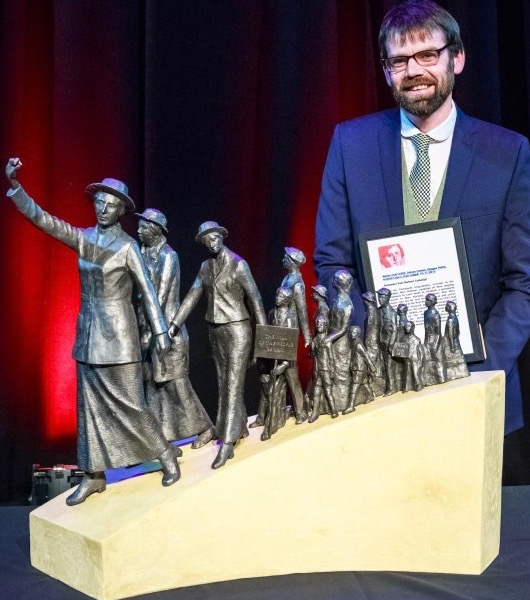 Photo: Eddie Middleton.
In February 2016 in Glasgow the name of the successful sculptor, Andrew Brown, chosen to create the statue of Mary Barbour, social reformer, was announced:
This sculptor’s intention was to present Mary Barbour, for now and for generations to come, in a way that captures the achievement for which she is best known. The day in November 1915, when she led a 20-thousand-strong protest through the streets of Glasgow to the Sheriff Court and won the victory.
Radical political activist Mary Barbour, born in Govan, successfully led the Rent Strikes in the city at the height of World War 1 forcing a change in the law with the introduction of the Rent Restrictions Act. Post-war, she maintained her vision and determination to deliver better policies for women and children across the city by blazing a trail to become the first Labour female councillor, Bailie and magistrate.
www.RememberMaryBarbour.com
This acheivement is only part of the sought-after result with hundreds of statues of men and just 20 statues of women across Scotland's civic landscape. See comments from Adele Patrick, founder of Glasgow Women's Library ( Nov 2015 )
"I think it is unbelievably empowering for girls - and boys - to grow up with the knowledge that women can do great things and can change the world."
Scotland's feminists call for statues to be erected to the ...
www.heraldscotland.com/news/14095360.Scotland_
and Janice Forsyth's amusing take on the situation in the Sunday Herald ( May 2013 )
"Unavoidably, such activities will result in human beings of the female persuasion being acknowledged, even celebrated, for their achievements. In Scotland. In the 21st century. I dread to think what could follow. An all-woman judging panel deciding on the future of Glasgow’s George Square? Pass me the smelling salts. Imagine the fiasco that could result from that!"
Just Janice: why a new female statue in Glasgow is long ...
www.heraldscotland.com/opinion/13105173.Just_Janice__why...
The Message of Public Art or No Taxation Without Representation?
Feb. 6, 2017
In the Guardian article ( 09.01.17 )" Britain to celebrate pioneering women with three new statues" the Labour MP Sarah Champion, who is shadow minister for women and equalities, said:
“The lack of women represented in public art can only be seen as a physical embodiment of how we fail to respect and recognise women’s achievements in our society.”
She said women’s taxes helped pay for the statues, yet our other contributions seemed unwanted because they were not publicly recognised.
“Public art sends a clear message on the qualities of leadership and achievement we value. By not recognising women leaders in this way, we are denying them a place in history. Worse, we are preventing them becoming visible role models for the next generation.”
It is a truth universally acknowledged.....
Feb. 3, 2017
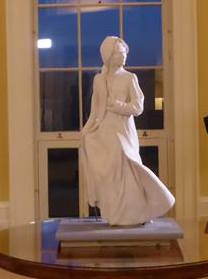
Maquette for Jane Austen statue by Adam Roud
To paraphrase Jane Austen's famous opening to Pride and Prejuduce; It is a truth universally acknowledged....that a civic statue in the UK is more likely to be of a man than a woman by a ratio approaching 10 to 1. Whether this huge discrepancy is a matter of pride or prejudice on the part of those empowered to erect public momuments remains a matter for discussion.
However, in Basingstoke there is now an active campaign to put up a statue to one of the nation's best loved authors, Jane Austen. 2017 will mark the 200th anniversary of her death. Strange that such a cultural icon should have had to wait so long for recognition in her own area.
*"It is a truth universally acknowledged, that a single man in possession of a good fortune, must be in want of a wife".
Jane Austen English novelist (1775 - 1817)
Jane Austen statue design unveiled in Basingstoke - bbc.co.uk
www.bbc.co.uk/news/uk-england-hampshire-38668736
Pride and Prejudice, first line
Britain to Celebrate more Great Women
Jan. 10, 2017
In the Guardian this week Helen Pidd, the North of England editor, writes that Suffragette Emmeline Pankhurst, MP Ellen Wilkinson and comic Victoria Wood are to be clebratated with public monuments.
"It has long been a sad truth that for a woman to be immortalised as a civic statue in the UK, she must either be a monarch – preferably Queen Victoria – or a naked nymph frolicking in a fountain. The male domination of public monuments may slowly be eroding, however, with three pioneering women to be celebrated in statue form in the next few years".
It is so good to hear that women are finally being given the recognition thay have deserved, but been denied for decades. This very, very slow recognition of women who have smashed glass ceilings, escaped from the hobbling effects of patriarchal attitudes and acheived despite the odds being stacked so heavilty against them, seems so dog in the manger. One wonders what the obstacles reallly are? Anybody would think there is a fear of acknowledging what women actually contribute to society.
Maureen Lipman Unveils Amy
Nov. 14, 2016
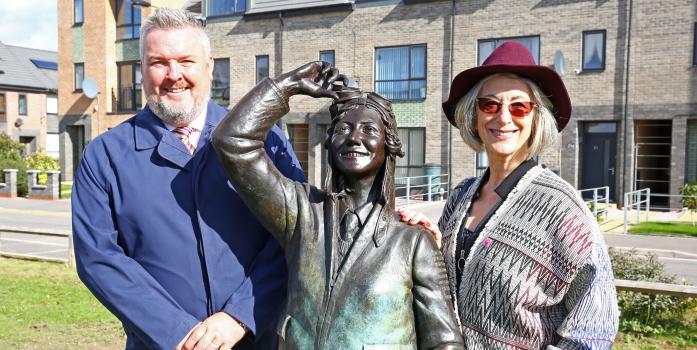
At the end of August 2016, Maureen Lipman unveiled the statue of Amy Johnson commemorating 75 years since her death. The unveiling marks the end of the Amy Johnson Festival; a celebration of Amy’s life, helping to raise awareness of her achievements as an aviator, as an engineer and as a woman of her time, and to encourage young women to consider engineering and the sciences as career choices through the presentation of positive role models and creative projects which explore technical, digital or mechanical ideas and applications, as well as to place Hull in an international context and to help set the scene for Hull UK City of Culture 2017.
Amy Johnson statues speak
Nov. 7, 2016
The two statues, one in Hull and one in Herne Bay, have different quotes set into their surfaces. The Herne Bay bronze quote on Amy's flying helmet is ‘believe nothing to be impossible” which was taken from a speech Amy gave in 1936. A second quote runs around the bottom of her jacket. This is what Amy said when Amelia Earhart disappeared in 1937 and it may have been Amy’s way of saying she knew she would go the same way and that was ok. It says “If I fail to find my mid-Pacific island let no one grieve for me or wish me any other fate. We all must finish our lives some time, and I infinitely prefer this end to the flu or senile decay. Rather grieve if I never have the chance to try.”
Amy Johnson
Oct. 19, 2016
Record breaking aviator Amy Johnson honoured by 2 statues
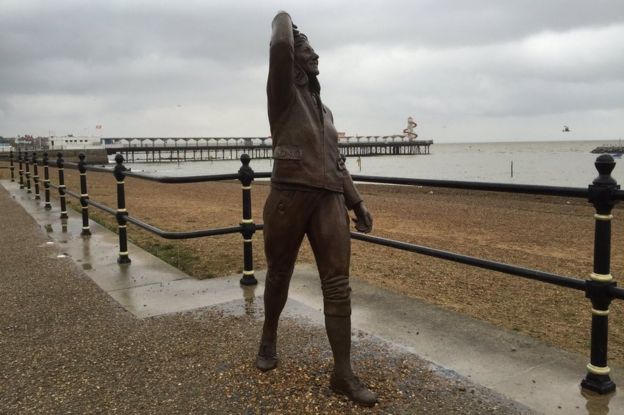 Image copyright Ian Sutton
In September 2016 a bronze statue to honour English aviator Amy Johnson was unveiled in Herne Bay, close to where she was last seen alive. In the same month another statue of her was unveiled by actress Maureen Lipman in Hull where Amy was born, to commemorate the 75th anniversary of the pilot's death. Amy Johnson's body and her plane were never recovered but her truly remakable achievements have now been honoured.
1929 Amy Johnson was the first woman in the UK to become an Air Ministry qualified ground engineer.
1930 the first woman to fly solo to Australia.
1931 the first pilot to fly from London to Moscow in one day.
1932 she flew solo from London to Cape Town in South Africa, breaking her husband's previous record by 11 hours.
1936 she regained her London to Cape Town record. This was her last long-distance flight.
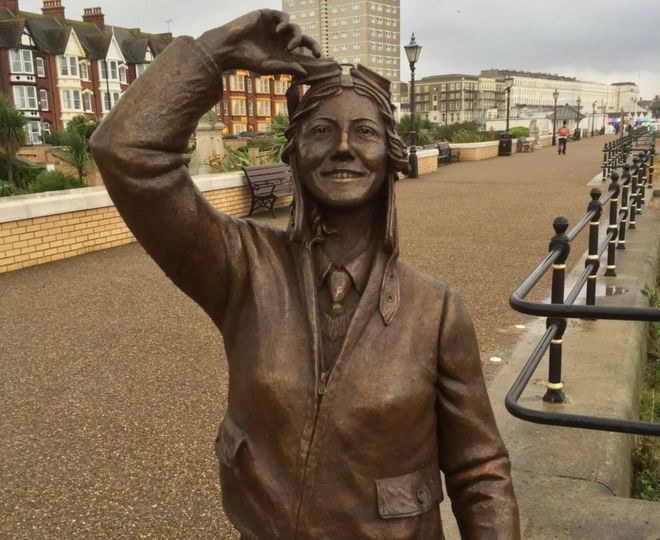 Image copyright Ian Sutton
The Herne Bay statue of Amy Johnson is close to where she ditched her plane in the sea
Campaigns increasingly meet a receptive audience
July 30, 2016
Celebrating Great Women on Britain's Streets Statues across the UK are predominantly of men, but campaigns to memorialise important women are increasingly meeting a receptive audience, writes Mark A Silberstein. In the past two years support has been growing for women statue campaigns across the UK including in places including Glasgow, Liverpool, London, Manchester, Middlesbrough, Belfast and Sheffield..... campaigners are being listened to by high-profile figures ….Councils across the country have also become more involved……
See full article and pictures at http://www.bbc.co.uk/news/magazine-36707152
We remember the Land Girls and Lumber Jills
July 30, 2016

'Without their help the nation would probably have starved'
A life size statue to honour their vital work was unveleid at the National Memorial Arboretum in Staffordshire in October 2014.
LAND GIRLS: 'THE FORGOTTEN ARMY'
Land Girls worked on farms to feed the nation when men went to war. The official minimum age was 17, but some lied and became Land Girls at 16 or even younger. Many had been barmaids, waitresses, maids, hairdressers or mill workers, and some enrolled straight from school.
With their uniform of green ties and jumpers and brown felt slouch hats, they toiled from dawn to dusk each day. They planted and harvested crops, tended animals and poultry, and delivered milk - all for £1.40 a week, with 70p deducted for board and lodging.
Often referred to as the 'Forgotten Army ', 20,000 surviving Land Girls were finally honoured in 2007 when the Government announced their efforts would be recognised with a commemorative badge.
Middlesbrough's Eighth Plinth
July 22, 2016

On International Women's Day 2016 a campaign was launched in Middlesbrough to secure a female statue in the town.There are seven statues in Middlesbrough - all men - and the Middlesbrough Statue Campaign aims to address this lack of representation of women with an Eighth Plinth for one of the women who have made great contributions to the life of the town.
There is a list of six remarkable yet unsung women from all walks of life, including politics, suffrage, health and art, which will be put to a public vote to find who will be commemorated with a statue. This will be paid for by a fundraising campaign with no funding from the public purse.
Campaign co-ordinator Emma Chesworth said: "A statue is a very visible and powerful symbol ....There are many remarkable women who lived and do live in Middlesbrough ....All too often, women are erased from history and their achievements never known or given the recognition they deserve."
Source: Middlesborough Council site.
For more information - http://eighthplinth.com
Women of Steel
June 23, 2016
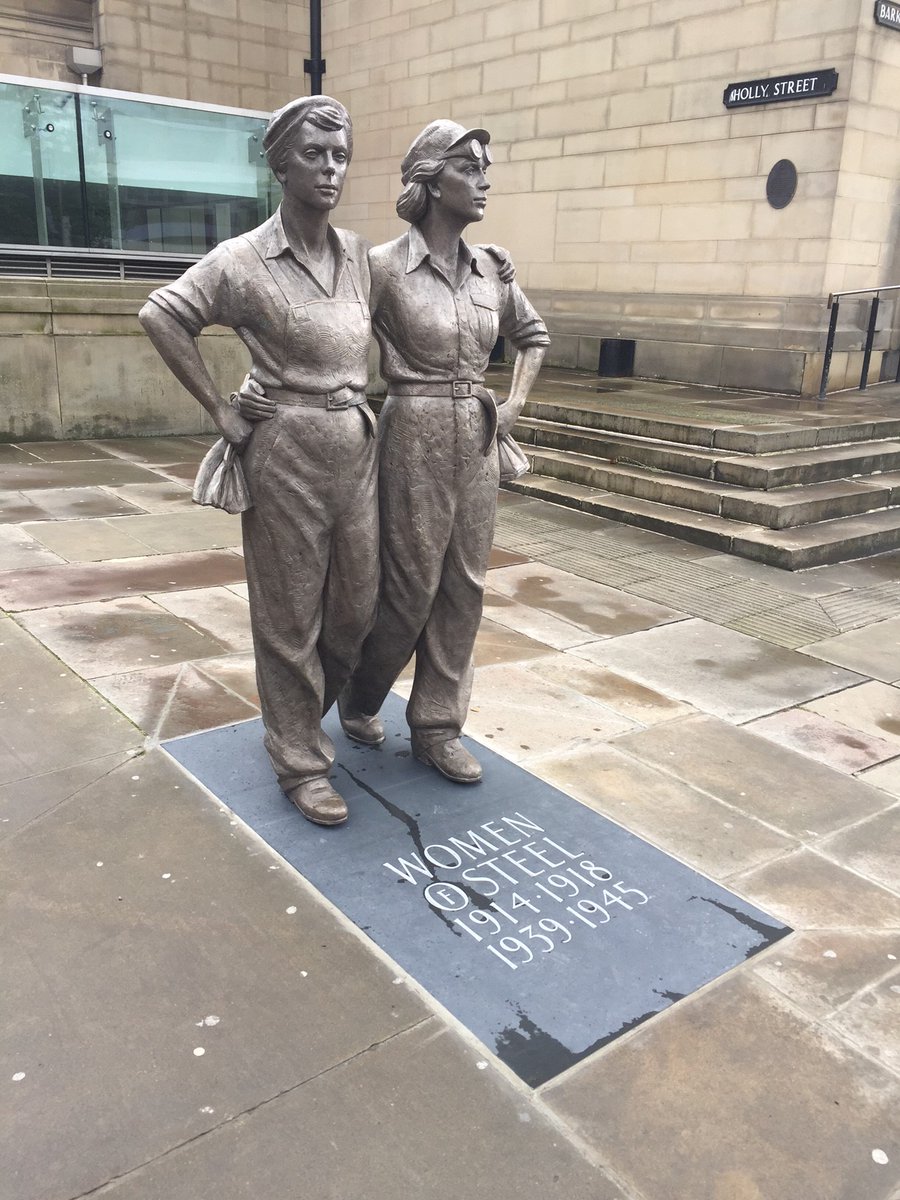
Above photo from @ShefACSE on Twitter
Sheffield City Council found that the “Women of Steel” statue was such a popular idea they raised even more than they needed to erect the statue so were able to strike commemorative medals to be presented to the surviving steel factory workers.
“Now in their late 80s, 90s and even 100s, we want Sheffield’s Women of Steel to be remembered and recognised for their efforts for years to come... a poignant memorial in the heart of Sheffield city centre, celebrating the Women of Steel.”
See the statue on the results page.
Are statues still relevant?
June 23, 2016
It is interesting to see the controversy around the Mary Seacole statue in London, with some arguing that a statue is an outdated way of celebrating a life and achievements. Although, given the sound and fury generated by this one it seems that a statue can be a very potent force. Perhaps it is more to do with the fact that it is a woman’s achievements, and a black woman’s achievements, which are being honoured, that brings out attempts to belittle and dismiss it?
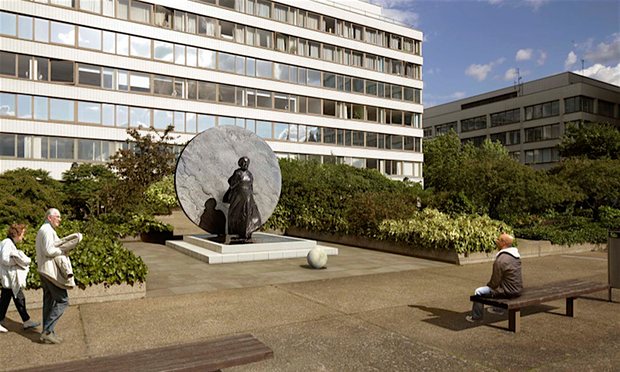
Above image of the proposed Mary Seacole statue: The Guardian
The matter is fully discussed in a number of papers, including the Daily Mail:
"Lessons in lies: How the BBC, school text books and even exam boards have twisted history to smear Florence Nightingale and make a saint of this woman..."
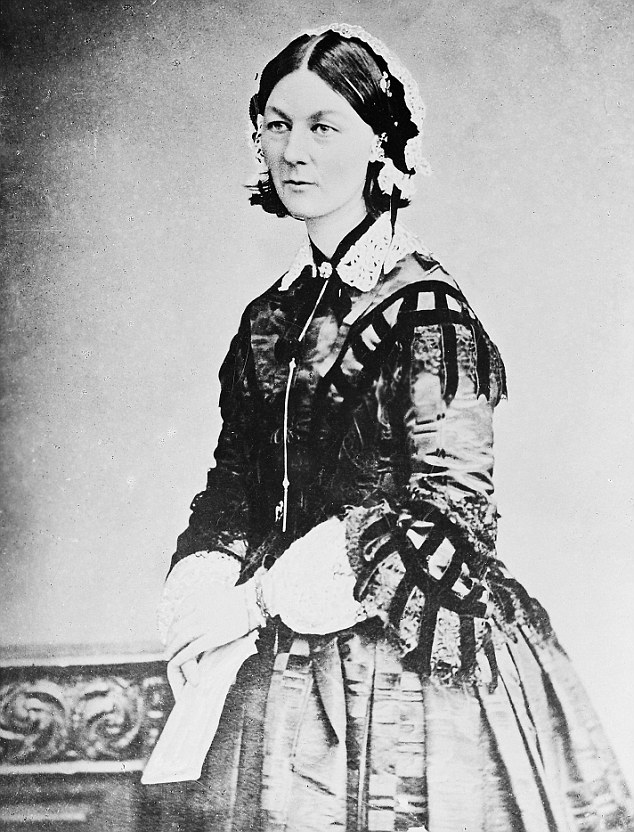
Above image of Florence Nightingale: the Daily Mail
and the Guardian
“Mary Seacole is an unsung heroine,” says Baroness Amos, director of the School of Oriental and African Studies…..“A Jamaican businesswoman, traveller and healer who wanted to go to Crimea to help treat the wounded and save lives, but was refused by the authorities. Rather than accept defeat, she went independently using her own money.”
and the Voice
…actress Suzanne Packer, who is an ambassador for the appeal said “The Mary Seacole Memorial Statue is so much more than a piece of art,” she said. “It represents a validation of her existence as a great human being and as we are all intrinsically linked through past, present and future it connects with my life and makes me proud, particularly as a black woman in this country, to have such a powerful and courageous role model.”
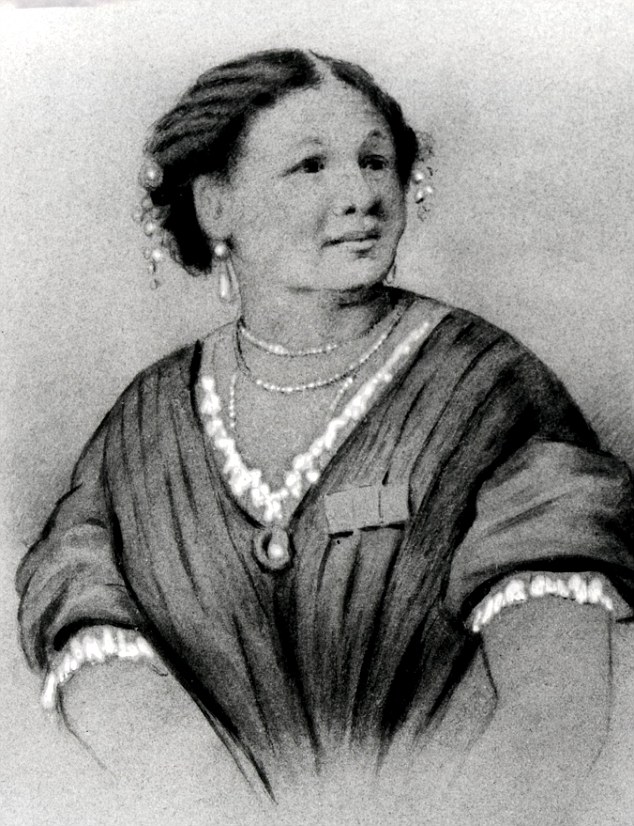
Above image of Seacole from the Daily Mail
AgeUK Interview
May 29, 2016
'Listen again' to an interview with Terri Bell-Halliwell on AgeUK's The Wireless Radio: click here.
Sylvia Pankhurst: East London suffragette may get a statue in Bow
May 25, 2016
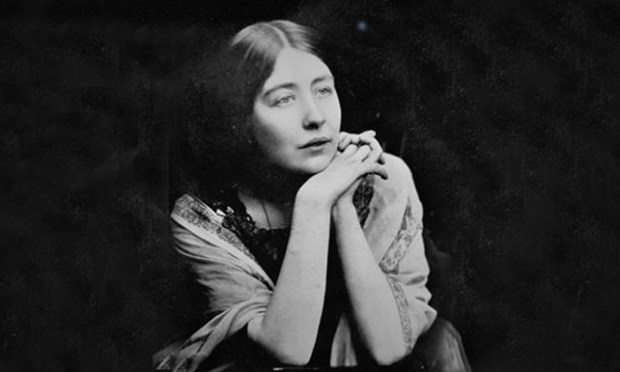
Above photograph: Roman Road Trust
Plans are in place to erect a statue in Bow of the radical feminist who founded the East London Federation of Suffragettes in 1913.
The Roman Road Trust, a community development organisation, wants the Pankhurst statue to be located on the junction of St Stephen’s Road and Roman Road.
It would form part of a wider public art trail focused on East End women such as Annie Besant, who played a prominent role in the Bow matchgirls strike of 1888.
“A lot of people don’t realise that Bow is the heartland of Sylvia Pankhurst,” said Tabitha Stapely, CEO of the Roman Road Trust.
“Due to the bombing in the war and various council initiatives to tidy up the area afterwards, there are no buildings or sites left of where Sylvia worked on Roman Road.”
“We want people to know the history, feel part of it and engage with it. So all these things have been leading up to the idea of celebrating her work with a statue.”
Read more on: East End Citizen

